
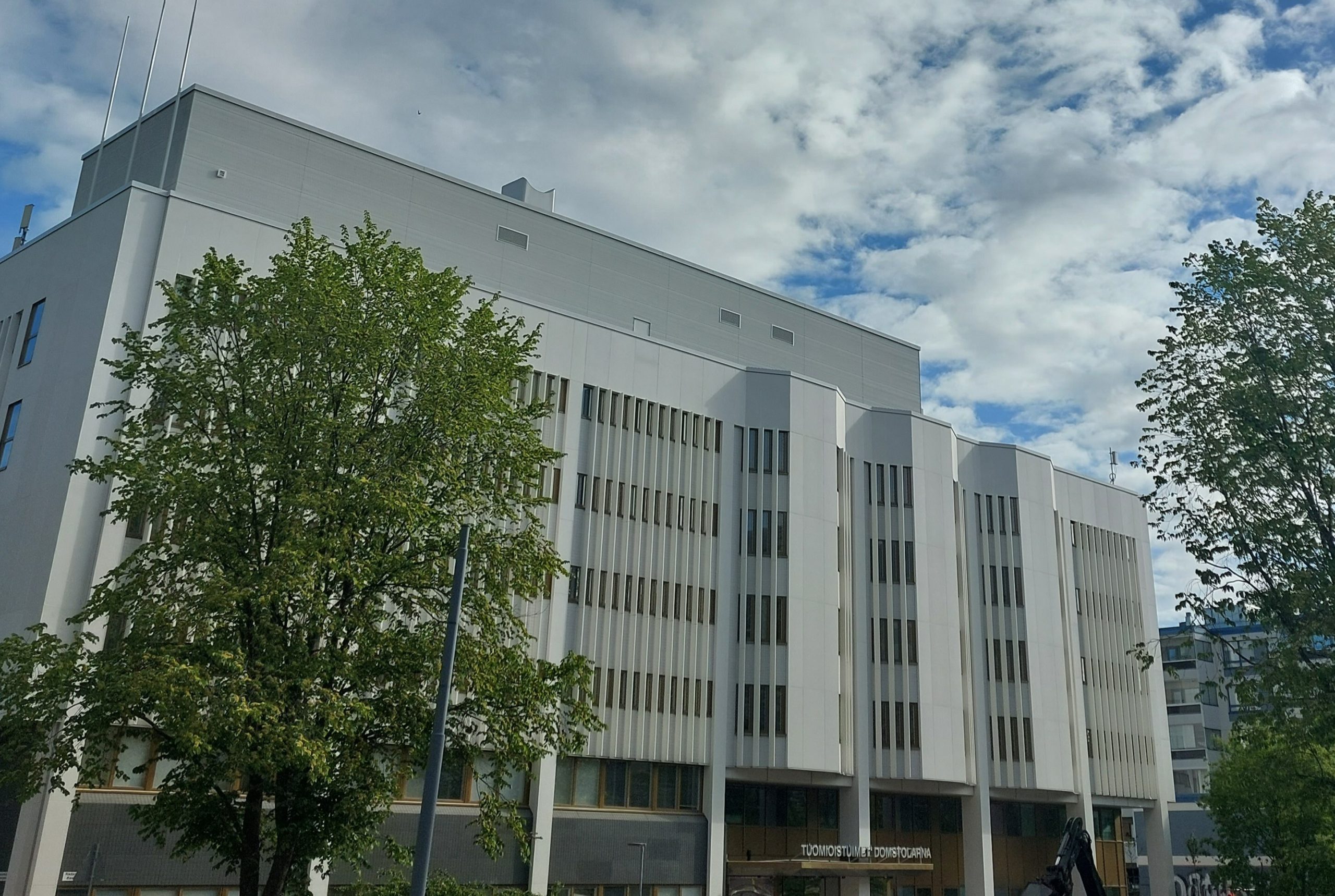
Labour Court of Finland
Contact info
Visiting and mail adress:
Radanrakentajantie 5,
00520 Helsinki, Finland
Telephone: +358 29 56 43350
Telefax: +358 29 56 43359
Email:
tyotuomioistuin(at)oikeus.fi
firstname.lastname(at)oikeus.fi
Establishment
In Finland collective agreements have been concluded ever since the latter part of the nineteenth century. The first Collective Agreements Act was passed in 1924. The number of collective agreements was small until the end of the Second World War and their impact was rather insignificant. In the spring of 1944 the central organizations of employers’ and employees’ associations signed the first document stipulating conditions of employment and even in the same year collective bargaining between the member associations of the central organizations in different fields was initiated.
After the end of the Second World War also the state undertook measures to adjust and improve the legislation concerning labour relations and labour disputes. The outcome of these measures was that the Parliament in 1946 amended the Collective Agreements Act and passed the Labour Court Act. These Acts came into force and the Labour Court started operating at the beginning of 1947.
The establishment of the Finnish Labour Court was firstly deemed necessary due to the fact that general courts of law were regarded as being too slow. Secondly, they were considered not to have the special expertise required in settling disputes arising out of collective agreements. In addition, it was considered significant that a court which was composed of members who represent the employers’ as well as the employees’ organizations, could gain the confidence of the labour organizations in a different manner than the general courts of law. Finally, the positive experiences in the other Scandinavian countries with their separate labour courts contributed to the establishment of the Labour Court.
By the time the Labour Court started operating the number of collective agreements concluded by the employers’ and employees’ associations was already quite significant. Almost all of the fields represented by the central organization of employers’ associations had by then already concluded their own collective agreements.
The existing Labour Court Act was passed in 1974. Later amendments concerning, inter alia, the system of civil servants’ collective agreements and the judicial procedure in the Labour Court have been passed.
Composition
The Labour Court is composed of a president and a vice-president, both of whom act as full-time chairmen of the court. In addition, there are 14 part-time members and each one of them has a sufficient number of deputies. The chairmen are appointed by the President of the Republic. The members, as well as their deputies, are appointed by the President of the Republic for a period of five years.
The operation of the Labour Court is based on the principle of tripartism. The president, the vice-president and two other members are appointed from among persons having the legal degree required for judges in Finland and who cannot be considered to represent either employers’ or employees’ interests. Other members are appointed upon the nomination by the most representative central organizations of the employers’ and employees’ associations. These members are not required to have a law degree but they must have a sound knowledge of labour relations or must be familiar with the employment relationships of civil servants.
Most cases are heard and tried in panels, where, in addition to a chairman and another so-called neutral member, two members representing the employers’ interests and two members representing the interests of employees are present.
In certain situations stipulated in the Labour Court Act, the chairman is able to rule upon a case alone provided that this is asked for by the parties concerned and the case is simple and does not involve any hearing of witnesses.
The president may decide that a case will be heard and tried in a plenary session of the court, if so required by consistency in the application of law, by the fact that the decision to be made in a particular case may have far-reaching consequences, or for any other important reason. The plenary session is attended by all 14 members and the vice-president together with the president who chairs the session.
Full-time referendaries prepare the judgments to be given and refer them to the Labour Court. Also the referendaries must be familiar with labour relations and they must hold the legal degree required for judges in Finland.
Procedure
The main features of the procedure in the Labour Court resemble the procedure in the regular courts of justice in Finland. The hearing of a case is divided into a preparatory stage and a main hearing. At first the preparation is conducted in writing, but normally there is also an oral hearing. The purpose of the preparation is to clarify the case so that it can be tried during the main hearing in one session without any postponements. In the preparation the plaintiff’s demands and the defendant’s response are brought forward, the specific issues in dispute are identified, and the material that the parties intend to present is gathered. After the preparation the main hearing, if needed, will take place. The main hearing consists primarily of the opening and final discussions of the parties and the hearing of witnesses.
The court may in urgent matters decide the case and pronounce the ruling immediately after the main hearing. This can be done for example in situations where there is an ongoing industrial action at the time of the main hearing. However, normally the court convenes for a so-called deliberative session to give its final decision in the matter. Subsequently, the written decision is mailed to the parties to the litigation.
Competence
Already from the start the competence of the Labour Court was enacted to be relatively narrow covering only legal disputes resulting from collective agreements. Under the existing law the Labour Court hears and tries the legal disputes arising out of collective agreements or collective civil servants’ agreements or out of the Collective Agreements Act or the Act on Collective Civil-Servant Agreements. A prerequisite for a matter to fall within the competence of the Labour Court is that the specific question involves the competence, validity, contents or extent of a collective agreement or the correct interpretation of a clause in such an agreement. In addition, cases in which it is questioned whether a course of action is in accordance with the collective agreements or Acts mentioned above fall within the competence of the Labour Court. The Labour Court also imposes the sanctions for a breach of these agreements and Acts. The possible sanction to be imposed by the Labour Court is a compensatory fine. In cases where the parties to the collective agreement have agreed on damages for a breach of the agreement the Labour Court can enter a judgment ordering such damages. The Labour Court is not empowered to impose a disciplinary sanction or a criminal sentence.
The amounts of compensatory fines are defined in the Collective Agreements Act and in different acts concerning the civil servants’ collective agreements. The amounts of compensatory fines are reviewed every three years to be adjusted for changes in the value of money. According to the Collective Agreements Act’s provisions that entered into force 18 May 2024, the amount of the compensatory fine imposed for a breach of the obligation to maintain industrial peace, or for failure to comply with the related supervisory duty, is a minimum of EUR 10,000 and a maximum of EUR 150,000. As of 1 January 2024, the compensatory fine imposed for a wilful breach of the provisions of a collective agreement, or for failure to comply with the related supervisory duty, is a maximum of EUR 37,400, and in the case of an individual employee a maximum of EUR 370. For special reasons, the compensatory fine may be adjusted or waived in its entirety. The compensatory fine is payable to the employers’ or employees’ organization winning the specific case.
Any court of law may request the Labour Court for an opinion in a matter which requires special knowledge in the field of employees’ or civil servants’ collective agreements. The court of law having requested the opinion is not, however, bound by it.
Collective agreements are accredited the status of general applicability by a special board. The boards’ decision can be challenged in the Labour Court which makes the final decision.
The Labour Court is not empowered to rule upon disputes arising out of individual employment contracts concluded between an employer and an individual employee or out of the legislation regarding employment relationships.
The territorial competence of the Labour Court covers the whole country. The decision of the Labour Court is final, and there is no ordinary appeal against its decisions to a higher instance. However, the so-called extraordinary means of appeal are available. In this procedure, judgments of the Labour Court may be annulled by the Supreme Court upon demand.